




































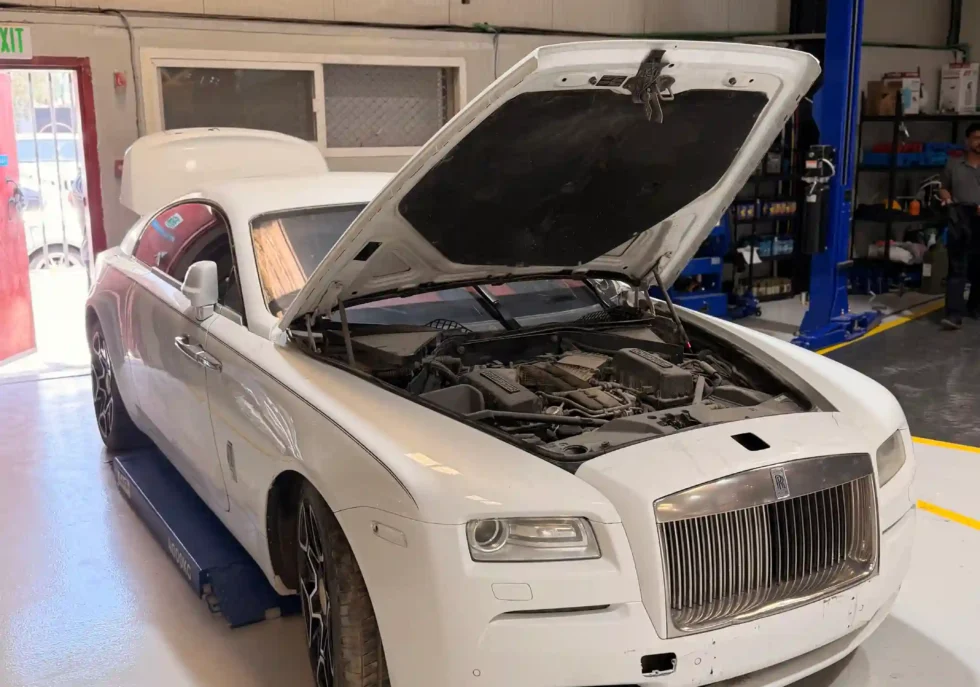
Why Is My Rolls-Royce Sitting Low on One Side or Sagging Overnight?
If your Rolls-Royce sits low on one side or sags overnight, the air suspension may be losing pressure through a leaking air spring, air line, fitting or valve block. A faulty ride-height sensor or suspension control problem can also leave the car uneven. If it rises again after starting, that doesn’t mean the fault has disappeared.
Park on level ground, photograph the wheel-arch gaps and check for suspension warnings. If the car is severely low, a tyre rubs or the handling feels unusual, don’t drive it. Arrange recovery and have the suspension inspected before replacing parts.
Is It Normal for a Rolls-Royce to Drop Overnight?
A small change in ride height after parking doesn’t always mean something is broken. Air suspension responds to changes in load, temperature and the vehicle’s levelling controls.
However, repeated or noticeable sagging deserves attention, particularly when the same corner drops every time.
For example, your Rolls-Royce might look perfectly level when you park it in the evening. The next morning, the front-left wheel arch is visibly closer to the tyre, while the other three corners look normal.
That pattern suggests the affected corner or its connected air circuit needs checking. It doesn’t prove the air spring itself has failed.
The important difference is whether the height change is minor and occasional or visible, repeated and getting worse.
There is no single overnight drop measurement that can be used to diagnose every Rolls-Royce model. A technician needs to compare the actual measurements with the correct vehicle specifications and operating conditions.
Which Part of Your Rolls-Royce Is Sitting Low?
The location and timing of the sagging help narrow down what might be happening.
| What You Notice | Possible Cause | Sensible Next Step |
|---|---|---|
| One front corner drops overnight | Air spring, air line, fitting or valve fault | Check the affected corner for pressure loss |
| One rear corner sits lower | Rear air spring, connection or valve fault | Compare both rear ride heights and inspect for leaks |
| Both rear corners drop | Rear suspension circuit, valves or levelling issue | Check rear height measurements and system operation |
| Car rises after starting | Automatic levelling is restoring height | Find out why the car lost height while parked |
| Car remains low after starting | Air supply, valve, control or significant leakage problem | Arrange professional diagnosis before driving |
| Car looks uneven with a warning message | Pneumatic, sensor or electronic fault | Read the stored suspension fault codes |
| Car looks uneven only on a sloped driveway | Parking surface may affect its appearance | Recheck on level ground |
These patterns are clues, not confirmed diagnoses. More than one fault can produce the same result.
Why Does a Rolls-Royce Sit Low on One Side?
1. A Leaking Air Spring or Air Strut
An air spring supports the vehicle using pressurised air inside a flexible rubber chamber.
Over time, the rubber can develop cracks, wear around its folding surfaces or lose its seal at a connection. If air escapes while the vehicle is parked, the affected corner may gradually sink.
You might notice:
- The same corner sits lower each morning.
- The vehicle becomes level again after starting.
- The height difference becomes more noticeable after longer parking periods.
- A suspension warning occasionally appears.
A leaking air spring is a possibility worth investigating, but these symptoms alone aren’t enough to justify replacing it.
A technician should confirm the leak and identify its location first.
2. An Air Line or Fitting Is Losing Pressure
Air lines carry pressurised air between suspension components. Their fittings are designed to maintain an airtight connection.
A damaged line, worn seal or leaking connection may allow a suspension corner to lose pressure even when the air spring itself is in good condition.
This matters because replacing an expensive air strut won’t fix a leak coming from its supply line.
The workshop should inspect accessible connections and use an appropriate leak-detection method to locate escaping air.
3. A Faulty Suspension Valve Block
The valve block controls how compressed air moves through the suspension system.
If a valve doesn’t seal correctly, air may escape through a circuit or move where it shouldn’t. The result can look similar to a leaking air spring.
One corner may drop after parking, or the front and rear may settle unevenly.
A valve-block problem cannot reliably be diagnosed just by looking at the car. The technician needs to check pressure retention, valve operation and the relevant air circuits.
A low corner doesn’t automatically mean the air strut needs replacing.
4. Incorrect Ride-Height Sensor Readings
Ride-height sensors help the suspension control system determine the vehicle’s position.
If a sensor, linkage, electrical connection or control signal is faulty, the system may receive incorrect height information.
It may then adjust the suspension incorrectly or display a warning.
Unlike an actual air leak, a sensor fault doesn’t necessarily mean air is escaping.
This is why physical ride-height measurements should be compared with the electronic readings during diagnosis.
5. A Weak Compressor or Air Supply Problem
The air suspension compressor supplies compressed air to the system.
If the compressor becomes weak, overheats or stops working, the car may struggle to reach its normal ride height.
However, a weak compressor doesn’t automatically explain why one corner loses height while parked.
A separate leak could be causing the overnight sagging, while the compressor struggles to replace the lost air.
Repeatedly running to compensate for a leak can also place additional strain on the compressor.
Before recommending compressor replacement, a garage should investigate the air supply and check for leaks elsewhere.
For a broader explanation of these components and their warning signs, read our Rolls-Royce air suspension problems guide.
Why Does My Rolls-Royce Rise Again When I Start It?
Your Rolls-Royce may rise after starting because the suspension control system is restoring its intended ride height.
Depending on the system and available pressure, the vehicle can use its air supply, valves and compressor to correct the height.
That explains why a car that looked low in the morning can appear normal again shortly afterwards.
But returning to normal height doesn’t prove the air suspension is healthy.
If a small leak remains, the vehicle may continue losing pressure whenever it is parked. The system might compensate each time it operates.
The pattern is particularly useful when explaining the problem to a technician:
- Does the same corner drop every night?
- Does the vehicle rise normally or slowly?
- Does the compressor seem to run more frequently than before?
- Does a warning appear during the correction?
- Does the vehicle stay level while driving but sink after being parked?
These details can help separate pressure loss from problems with air supply or electronic levelling.
What Can You Safely Check Before Visiting a Garage?
You don’t need to dismantle the suspension to gather information that helps with diagnosis.
Step 1: Park on Level Ground
Choose a flat, suitable parking area.
A sloping driveway or uneven parking space can make the vehicle appear tilted even when its suspension is operating correctly.
Make sure the tyres are properly inflated, as an underinflated tyre can also affect how the car sits.
Step 2: Photograph All Four Corners
With the vehicle safely parked, take clear photographs of the wheel arches and tyres.
Try to keep the camera in the same position and at the same height each time.
If the problem appears overnight, take another set of photographs before the vehicle is unlocked or started, where practical. Some suspension systems can adjust their height when activated.
Step 3: Compare the Ride Height
Look at the visible gap between each tyre and wheel arch.
If you want a more consistent record, measure vertically from the wheel centre to the wheel-arch edge at each corner, without reaching beneath the vehicle.
Use the same measuring points and parking conditions when comparing readings.
A difference tells you where the car is sitting low. It doesn’t identify which component is defective.
Step 4: Check for Warning Messages
Photograph any suspension or chassis warning on the dashboard.
Write down when the message appears and whether it disappears after the vehicle reaches its normal height.
Don’t clear stored fault codes simply to remove a warning. Those records may help the workshop identify the problem.
Step 5: Note What Happens After Starting
If the vehicle is not severely low or showing signs of an immediate safety problem, observe whether it returns to normal height.
Don’t repeatedly operate the height controls or leave the compressor trying to lift a vehicle that cannot recover.
Important: Never crawl underneath a Rolls-Royce to inspect its air suspension without proper professional lifting and support equipment. Air suspension can change height unexpectedly. Don’t disconnect air lines or attempt to release system pressure yourself.
Can I Drive My Rolls-Royce If One Side Is Low?
Do not drive if the vehicle is severely low, a tyre is touching the wheel arch, ground clearance is unsafe, or the steering and handling feel abnormal. Arrange recovery instead.
Driving with a serious suspension fault can affect clearance, tyre contact and vehicle control.
If the height difference is slight, the car otherwise behaves normally and there is no critical warning, the situation may be less urgent. However, it still needs investigation. A remote description cannot establish that the vehicle is safe to drive.
Avoid assuming that the problem is harmless simply because the vehicle lifts back to its normal height after starting.
If you’re unsure whether the suspension has enough clearance to operate safely, contact a specialist before moving the car.
How Does a Garage Find the Cause of Overnight Sagging?
A reliable diagnosis should establish whether the suspension is physically losing pressure or receiving incorrect control information.
1. Check the Vehicle and Fault History
The technician should confirm the exact Rolls-Royce model, year and relevant suspension configuration.
They should also ask whether the car sinks while parked, takes longer to rise, or displays a warning.
2. Measure the Ride Height
The car’s height is measured on a level surface and compared with the appropriate technical specifications.
This helps confirm whether the vehicle is genuinely outside its intended position.
3. Read the Suspension Fault Codes
A compatible diagnostic tool can retrieve stored faults and inspect relevant sensor readings.
A fault code helps direct the investigation but doesn’t necessarily identify the failed component.
4. Check for Air Leaks
The technician can inspect air springs, fittings, air lines and valves using suitable leak-detection methods.
A leak may appear only at a particular suspension height or under certain conditions, so a quick visual inspection might not be enough.
5. Carry Out Pressure-Retention Testing
Where supported by the vehicle’s service procedures, the workshop can test whether an air circuit holds pressure over time.
Further testing can help distinguish a leaking air spring or pipe from an internal valve leak.
6. Confirm the Repair and Recheck the System
Once the failed component is identified, the workshop can explain the repair options.
After work is completed, the suspension may require appropriate functional checks, fault-code review and ride-height calibration where specified.
The result should be checked rather than assuming the problem is fixed because the car looks level immediately after repair.
Should I Replace One Air Strut or Both?
Replacing both sides is not automatically necessary whenever one corner loses height.
The decision depends on the failed component, the condition of the opposite side, the vehicle’s specifications and the repair guidance for the fitted parts.
If one air strut has a confirmed leak and the other remains serviceable, a single-component repair may be possible.
If both units show significant wear, the workshop may recommend replacing a pair for consistent condition and performance.
Ask whether the second replacement is technically required or recommended because of its condition.
Also ask whether the quotation includes only the air strut or additional work such as fittings, diagnostics and calibration.
There is no reliable universal repair price for this symptom. A Ghost, Phantom or Cullinan may require different components, and the cost depends on what the testing actually finds.
Can Dubai’s Heat Make Air Suspension Sagging Worse?
Dubai’s high temperatures can contribute to ageing in rubber and plastic components, while repeated heat cycles may affect seals and connections over time.
But heat alone isn’t proof that an air spring, valve block or compressor has failed.
There is another distinction worth understanding: air pressure responds to temperature changes. A vehicle parked in warm conditions and measured again after a cooler night may show some change.
That doesn’t explain away severe, repeated one-sided sagging.
If the same corner regularly drops, the correct response is to investigate the system rather than assume the weather is responsible.
For owners dealing with other warning signs, our guide to common Rolls-Royce problems in Dubai covers related cooling, electrical, suspension and maintenance concerns.
Does the Problem Affect Every Rolls-Royce Model in the Same Way?
Rolls-Royce Ghost, Phantom, Cullinan, Wraith and Dawn models use sophisticated suspension systems, but their component layouts and control arrangements are not identical.
For example, the second-generation Ghost includes Rolls-Royce’s Planar Suspension System, combining self-levelling air struts with electronically controlled dampers and additional front suspension technology.
That doesn’t mean every older Ghost, Wraith or Phantom uses the same arrangement.
The symptoms of an air leak may look similar across models, but the correct tests, replacement parts and calibration procedures must be matched to the specific vehicle.
A specialist should therefore confirm the model and vehicle identification details before ordering parts or applying a diagnostic procedure.
When Should You Book a Rolls-Royce Suspension Inspection in Dubai?
If your Rolls-Royce regularly drops overnight, one corner sits visibly lower, or the vehicle struggles to recover its normal height, it’s time for a proper inspection.
You don’t need to know whether the fault is an air spring, compressor or valve block before contacting a garage.
At Station One Autos, our independent workshop in Al Quoz provides suspension diagnostics and repair services for Rolls-Royce vehicles.
Our team can inspect the symptoms, explain the findings and provide a repair estimate before work begins.
For details or to arrange an appointment, visit our Rolls-Royce service and repair page in Dubai.
Workshop: Station One Autos, 18th Street, Al Quoz Industrial Area 1, Dubai, UAE.
Contact: +971 58 652 2602
Frequently Asked Questions
1. Why is my Rolls-Royce lower on one side?
A leaking air spring, damaged air line, faulty valve or incorrect ride-height sensor reading can leave one side lower than the other. The affected corner helps narrow down the investigation, but the failed component must be confirmed through inspection and testing.
2. Is overnight sagging normal on a Rolls-Royce?
A small height change can occur because of temperature or normal levelling behaviour. However, a noticeable drop that repeats overnight, especially at the same corner, isn’t something to ignore. Have the suspension checked if the problem continues.
3. Why does my Rolls-Royce suspension rise after starting?
The suspension control system may be restoring pressure and correcting the vehicle’s ride height. This doesn’t rule out a leak. If the car regularly sinks while parked and rises again after starting, the pressure-retention system should be checked.
4. Does one low corner mean my air strut has failed?
No. An air strut leak is one possibility, but a leaking fitting, air line or valve can produce the same appearance. Replacing the strut without confirming the source of pressure loss may leave the original problem unresolved.
5. Can a ride-height sensor cause a Rolls-Royce to sit unevenly?
Yes. Incorrect sensor feedback or a control problem can cause the suspension to adjust to the wrong position. A technician should compare actual ride height with sensor data to determine whether the fault is electronic, pneumatic or mechanical.
6. Can I drive my Rolls-Royce with a suspension warning?
It depends on the warning and how the vehicle behaves. If the car is severely low, rubbing a tyre, handling abnormally or displaying a serious chassis warning, don’t drive it. Arrange professional advice or recovery.
7. Why does the rear of my Rolls-Royce sag overnight?
Rear sagging can result from pressure loss in a rear air spring, fitting, air line or valve circuit. If both rear corners drop together, the workshop should investigate the rear suspension system and its controls rather than assume both air springs have failed.
8. Can a faulty compressor cause overnight sagging?
A faulty compressor may stop the suspension from maintaining or restoring its intended height. However, a car that physically loses height while parked may have an air leak or valve issue. Both air supply and pressure retention should be checked.
9. Will replacing the compressor solve the sagging problem?
Only if the compressor is confirmed to be part of the fault and the underlying cause has been addressed. A leaking air spring or valve may continue losing pressure after compressor replacement. Proper testing helps prevent unnecessary parts replacement.
10. How do I know whether my Rolls-Royce needs suspension repair?
Repeated visible sagging, uneven height on level ground, slow recovery, unusual compressor operation or suspension warning messages all justify inspection. A diagnostic assessment can determine whether the problem needs a component repair, adjustment or another corrective action.